Forklift Safety Projection Lights: A Practical Guide for Warehouses and Factories
Forklifts operate close to pedestrians every day in warehouses, manufacturing plants, loading areas, and distribution centers. Blind corners, intersections, noisy environments, and limited visibility can make it difficult for workers to recognize an approaching forklift in time. A forklift safety projection light adds a highly visible visual warning around or ahead of a moving forklift. […]
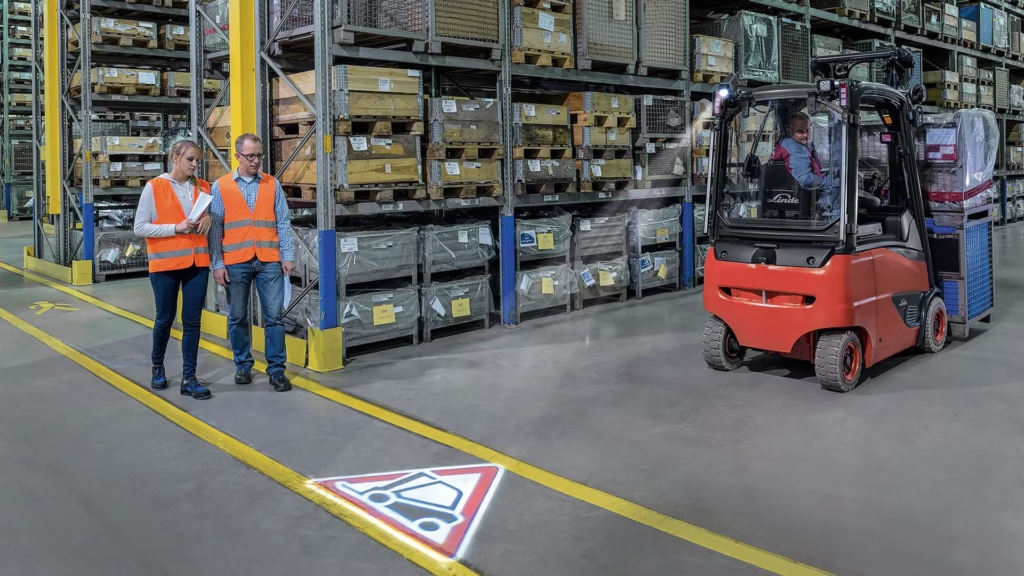
Forklifts operate close to pedestrians every day in warehouses, manufacturing plants, loading areas, and distribution centers. Blind corners, intersections, noisy environments, and limited visibility can make it difficult for workers to recognize an approaching forklift in time.
A forklift safety projection light adds a highly visible visual warning around or ahead of a moving forklift. Depending on the product and application, it can project a line, arrow, warning symbol, or other visual boundary onto the floor.
What Is a Forklift Safety Projection Light?
A forklift safety projection light is a vehicle-mounted visual warning device designed for industrial material-handling environments.
Common projected warnings include:
- Red or blue safety lines
- Directional arrows
- Warning zones around the forklift
- Pedestrian warning symbols
- Forklift approach indicators
Unlike painted floor markings or adhesive tape, the projected warning moves with the forklift. This makes it useful when the hazard itself is moving.
What Safety Problem Does It Solve?
The main purpose is to improve visual awareness between forklifts and pedestrians.
Typical applications include warehouse aisles, blind corners, intersections, production areas, loading zones, pedestrian crossings, and other locations where forklifts operate close to workers.
For example, a side-mounted line light can create a visible boundary beside the forklift. A forward-facing projection light can provide an advance visual warning that a forklift is approaching.
The projection should be treated as an additional visual warning measure rather than a replacement for physical barriers, traffic management, operator training, or other required safety controls.
Why Use Projection Instead of Only Traditional Warning Lights?
Traditional beacon and audible alarms remain useful, but industrial environments can contain multiple vehicles, machines, alarms, and other distractions.
Projection provides information directly on the floor where pedestrians may encounter the vehicle.
It can offer several practical advantages:
Clear visual position.
The warning can show where the forklift is approaching or indicate a defined safety boundary.
Moves with the vehicle.
Unlike fixed floor markings, the warning follows the forklift.
No floor contact.
Projected markings are not physically worn away by forklift tires.
Different warning formats.
Lines, arrows and other patterns can be selected according to the application.
Works alongside other safety devices.
Projection lights can be used together with beacons, audible alarms, mirrors, barriers, sensors and traffic-management systems.
Where Are Forklift Projection Lights Commonly Used?
Warehouse aisles
A projected line or warning can help pedestrians recognize the operating space around a moving forklift.
Blind intersections
Forklifts approaching an intersection may not be immediately visible to pedestrians approaching from another direction. Visual warnings can provide additional awareness.
Pedestrian areas
Where pedestrian routes and forklift traffic are close together, projection can reinforce the intended separation between people and vehicles.
Manufacturing facilities
Production environments often contain machines, materials, vehicles and workers within relatively limited space. Additional visual warnings can help make forklift movement easier to identify.
Loading and staging areas
These areas frequently have changing traffic patterns. Vehicle-mounted warnings can move with the forklift rather than depending entirely on permanent floor markings.
How to Select a Forklift Safety Projection Light
A suitable product should be selected according to the actual application rather than simply choosing the highest wattage.
Important information includes:
| Parameter | Why It Matters |
|---|---|
| Application | Determines the required warning type |
| Forklift voltage | Determines electrical compatibility |
| Mounting position | Affects warning direction and visibility |
| Projection distance | Influences projected size and intensity |
| Ambient light | Affects visibility |
| Required line/pattern size | Determines optical requirements |
| Floor surface | Influences contrast |
| Indoor/outdoor use | Affects environmental requirements |
| Operating hours | Relevant to product durability |
| Warning color/pattern | Depends on the intended application |
For projects with uncertain site conditions, testing a small number of units before bulk deployment can reduce selection risk.
Projection Light vs. Fixed Floor Marking
Neither solution is universally better.
Paint and floor tape are simple and economical for permanent traffic routes. Physical barriers provide a stronger form of separation where they are practical and appropriate.
Projection becomes particularly useful when the warning needs to move with the forklift, when physical floor markings experience heavy wear, or when a more noticeable visual warning is required.
The correct question is therefore not:
“Can projection replace floor markings?”
It is:
“Which warning method is appropriate for this specific safety problem?”
From Pilot Testing to Fleet Deployment
For a new application, a practical implementation process is:
Safety Problem → Site Conditions → Product Configuration → Pilot Test → Validation → Bulk Deployment
During a pilot test, the customer should evaluate the warning under actual operating conditions, including ambient lighting, floor conditions, viewing distance, mounting position, forklift movement and pedestrian visibility.
Once the configuration has been validated, the same setup can be considered for similar forklifts, operating areas, warehouses or other sites.
Conclusion
Forklift safety projection lights are not simply additional lamps mounted on a vehicle. Their value comes from presenting a visible warning at the location where forklift and pedestrian movement may create risk.
The effectiveness of the solution depends on selecting the correct projection type, mounting position, voltage, projection distance, warning size and optical configuration for the actual environment.
For distributors, system integrators and industrial end users, providing basic site information before product selection is one of the most effective ways to reduce installation problems and improve the success of a forklift safety lighting project.
SNT Engineering & Selection Framework
Related Technical Articles & Engineering Guides
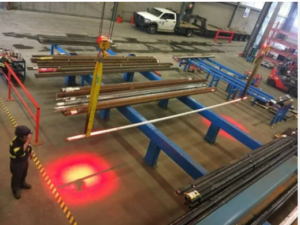
How Crane Warning Lights Create Visible Hazard Zones Below Overhead Loads
Crane warning lights project visible lines, spots or symbols onto the floor to improve awareness of overhead crane…
How to Choose an LED Safety Line Projector for a Warehouse
Mounting height, required line length, ambient light and installation geometry matter more than wattage alone. This practical guide…
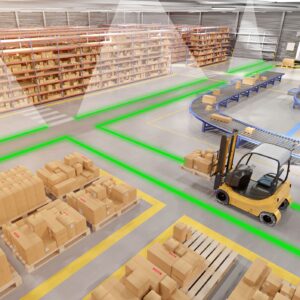
Virtual Safety Signs vs. Floor Paint and Tape: Which Works Better in Industrial Facilities?
Floor paint and tape remain useful for permanent markings, but projected safety signs offer a flexible, non-contact option…